Starbucks Nutrition
The Complete Starbucks Nutrition Guide for Healthy
Best Complete Guide to Calories, Protein, and Smarter Choices
Updated 2026 | Aligned with USDA Dietary Guidelines | FAQ Schema Included
Millions of people visit Starbucks every day, yet most have no idea how many calories, grams of sugar, or milligrams of caffeine are in their cup.
According to the USDA, the average American consumes 300 to 400 calories per day from beverages alone and a single specialty drink can account for a significant share of that.
Understanding what you are drinking is not about guilt. It is about making choices that actually work for your body and your goals.
This guide covers everything from drink calories to detailed breakdowns of starbucks egg bites nutrition, starbucks spinach feta wrap nutrition, starbucks jalapeno chicken pocket nutrition, and much more.
You will also find guidance on using the starbucks nutrition calculator, internal links to related topics, a fully structured FAQ section, and schema implementation notes for website publishers.
Related Guides on This Site
Before diving in, here are some related articles you may find useful:
- Starbucks Calories Calculator → /starbucks-calories-calculator
- Healthy Coffee Drinks Guide → /healthy-coffee-drinks
- Low-Calorie Breakfast Guide → /low-calorie-breakfast-ideas
- Best Protein Coffee Drinks → /protein-coffee-drinks
- Matcha Nutrition Guide → /matcha-nutrition-benefits
Where to Find Official Starbucks Nutrition Information
Starbucks publishes its complete nutrition data Starbucks nutrition facts on its official website and mobile app. For every item, the starbucks nutrition menu lists calories, total fat, saturated fat, sodium, carbohydrates, sugar, protein, and caffeine.
In the United States, this labeling follows FDA standards that require chain restaurants with 20 or more locations to display calorie information on menus so the numbers you see in-store are legally required to be accurate.
For custom orders, the Starbucks Calories Calculator is your best tool. These free online tools particularly starbucks nutrition calculator usa versions let you select your drink, size, milk type, syrup pumps, and toppings to generate a real-time breakdown.
A downloadable starbucks nutrition pdf is also available on the official site for offline reference.
Pro Tip: Bookmark the Starbucks app or a reliable starbucks drink nutrition calculator before your next visit. Checking before you order takes less than 60 seconds and can save you hundreds of calories a week.
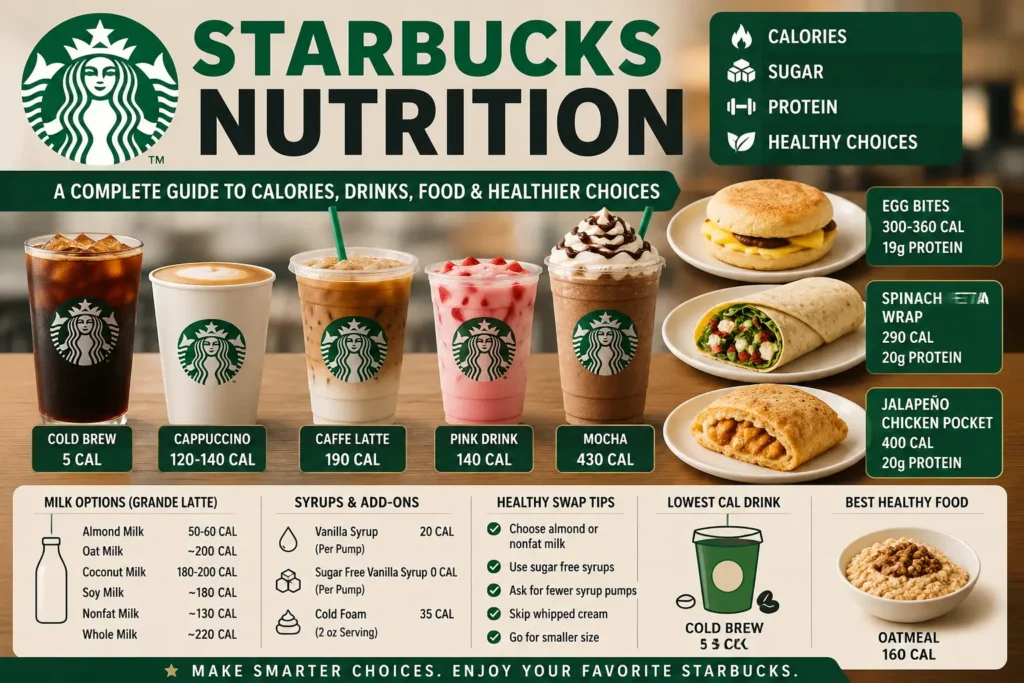
Starbucks Drinks Calories From 5 to 430 in One Menu
The calorie range across the drink menu is wider than most people expect. A plain Cold Brew and a White Chocolate Mocha are both just “coffee drinks” — but nutritionally they are completely different. All figures below are for a Grande (16 oz) serving.
The Light End: 0 to 150 Calories
- Cold Brew Black: Just 5 calories. The cleanest, leanest option on the entire menu pure coffee, zero additives.
- Americano: Around 15 calories. Espresso with water, simple and effective.
- Cappuccino: 120 to 140 calories a traditional espresso drink with steamed milk and a thick layer of foam.
- Starbucks Pink Drink Nutrition: 140 calories and 24g of sugar in a Grande, made with a coconut milk and strawberry acai base. It is lighter than it looks.
The Light End: 0 to 150 Calories
| Drink | Calories (Grande) | Nutrition Notes |
|---|---|---|
| Cold Brew Black | 5 cal | Pure coffee with zero additives the lightest option on the menu |
| Americano | 15 cal | Espresso with water, simple and low-calorie |
| Cappuccino | 120-140 cal | Traditional espresso drink with steamed milk foam |
| Starbucks Pink Drink | 140 cal | Contains 24g sugar with coconut milk and strawberry acai base |
The Middle Ground: 150 to 280 Calories
| Drink | Calories (Grande) | Nutrition Notes |
|---|---|---|
| Caffe Latte | ~190 cal | Smooth and creamy with whole milk |
| Brown Sugar Shaken Espresso | ~200 cal | Popular oat milk espresso drink with moderate calories |
| Starbucks Chai Tea Latte | ~240 cal | Contains around 42g sugar in a Grande |
| Starbucks Matcha Latte | 240–280 cal | Provides antioxidants but includes sweetened matcha blend |
| Caramel Macchiato | ~250 cal | Vanilla syrup and caramel drizzle increase calories |
The Indulgent End: 380 Calories and Above
| Drink | Calories (Grande) | Nutrition Notes |
|---|---|---|
| White Chocolate Mocha | ~430 cal | One of the richest and highest calorie drinks on the menu |
| Caramel Frappuccino | 380–420 cal | Blended drink with high sugar and calorie content |
Internal Link: For a full breakdown of every blended drink, see our Starbucks nutrition Calculator guide.
Which Milk Is Actually the Healthiest Choice at Starbucks?
Your milk choice is one of the single biggest levers for changing the nutrition count of your drink often more impactful than drink size. Registered dietitians consistently highlight this as the easiest modification most people overlook.
Is Almond Milk the Best Low-Calorie Option?
Starbucks almond milk nutrition makes it one of the lowest-calorie choices available, adding just 50 to 60 calories to a Grande latte. It is plant-based, lactose-free, and widely available. The trade-off is that it is low in protein compared to dairy, so it may not be the best choice if you need your drink to be filling.
Oat Milk: Rich Texture, Slightly Higher Carbs
Starbucks oat milk nutrition (also listed as starbucks oatmilk nutrition) gives drinks a noticeably creamier texture. A Grande latte with oat milk reaches around 200 total calories. The carbohydrate content is higher than almond or coconut milk, which is relevant for anyone monitoring blood sugar.
Coconut, Soy, and Dairy: Filling Out the Options
- Starbucks Coconut Milk Nutrition: Adds a light tropical flavor and 180 to 200 calories per Grande drink. Higher in saturated fat than other plant-based milks.
- Starbucks Soy Milk Nutrition: A solid plant-based protein source at around 180 calories per Grande latte. The Harvard T.H. Chan School of Public Health recognizes soy as one of the most nutritionally complete plant proteins available.
- Whole Milk: 220 calories the richest option and highest in saturated fat.
- Nonfat Milk: Around 130 calories — lightest dairy choice with a good calcium and protein profile.
Quick decision rule: choose almond milk or nonfat milk to cut calories; choose soy or nonfat dairy for protein; choose oat milk for texture and flavor.
Related: See our full Low-Calorie Breakfast Guide for how to pair your drink with the right food choice.
Starbucks Protein Options: Coffee Macros Cold Foam, Lattes, and Smart Add-Ons
Starbucks has meaningfully expanded its protein-forward menu in recent years.
According to guidelines from the American Diabetes Association, pairing a lower-calorie drink with a protein-rich topping or food helps stabilize blood sugar and reduces mid-morning hunger making this section particularly useful for those managing their energy levels through the day.
Higher-Protein Drink Options
Higher-Protein Drink Options
Looking for more protein-rich choices? Explore our High-Protein Starbucks Drinks guide for more options with calories and protein details.
- Starbucks Protein Latte Nutrition: Over 200 calories and 15 or more grams of protein…
- Starbucks Protein Matcha Nutrition: Combines matcha antioxidants with added protein.
- Starbucks Protein Milk Nutrition: Using protein-enhanced milk as your base…
Protein Cold Foam: Light Topping, Real Benefits
Starbucks protein cold foam nutrition sits at approximately 40 to 45 calories per serving with 4 to 5 grams of protein.
Made with low-fat milk and protein powder, this topping adds texture and a small but meaningful protein boost without dramatically changing your total calorie count.
The vanilla version brings around 50 calories and keeps the same protein level, while the banana variant adds roughly 55 calories with a natural sweetness.
Both are a worthwhile upgrade from plain cold foam for anyone prioritizing protein intake.
Internal Link: Explore more options in our Best Protein Coffee Drinks guide.
Higher-Protein Drink Options
- Starbucks Protein Latte Nutrition: Over 200 calories and 15 or more grams of protein a genuine meal-replacement option for active individuals.
- Starbucks Protein Matcha Nutrition: Combines matcha antioxidants with added protein. A balanced, energizing morning drink.
- Starbucks Protein Milk Nutrition: Using protein-enhanced milk as your base adds a natural boost without significantly changing the flavor.
Ultimate Starbucks Food Nutrition: What Is Actually Worth Ordering?
Starbucks food has improved considerably in nutritional quality over the past few years. Here is a category-by-category breakdown of the most commonly ordered items, starting with the best overall options.
Egg Bites: The Highest-Protein Breakfast on the Menu
Starbucks egg bites nutrition makes them one of the most nutritionally complete items available. Sous-vide cooked and rich in protein, they hold up well as a proper breakfast rather than a snack.
- Starbucks Egg White Bites Nutrition: The lightest version 170 calories and 13g of protein. The USDA daily protein recommendation for an average adult is 50 to 60g, and a serving of these covers roughly a quarter of that.
- Starbucks Bacon Egg Bites Nutrition: 310 calories and 19g of protein. The bacon adds flavor and fat alongside a strong protein count.
- Starbucks Bacon Gruyere Egg Bites Nutrition: 300 calories and 19g of protein with a richer flavor from the Gruyere cheese
For most people, egg bites paired with a lower-calorie drink is one of the most nutritionally sound combinations available at any major coffee chain.
Wraps and Sandwiches: Balanced Meals You Can Feel Good About
- Starbucks Spinach Feta Wrap Nutrition: Also referred to as starbucks feta wrap nutrition or starbucks spinach feta egg white wrap nutrition 290 calories and 20g of protein. One of the most popular and well-balanced vegetarian options at a quick-service restaurant.
- Starbucks Turkey Bacon Sandwich Nutrition: 230 calories and 17g of protein. Dietitians frequently highlight this as one of the most nutritionally sensible sandwiches available at any major chain.
- Starbucks Egg Pesto Mozzarella Sandwich Nutrition: 380 calories and 19g of protein. More indulgent but still protein-rich, making it a filling choice for a larger appetite.
These three options cover a wide calorie range without sacrificing protein. Any of them pair well with a simple black coffee or americano for a complete, under-500-calorie meal.
Pockets and Bakes: Hearty Handheld Options
- Starbucks Jalapeno Chicken Pocket Nutrition: Around 400 calories and 20g of protein with a spicy, satisfying filling. Also commonly searched as jalapeno chicken pocket starbucks nutrition.
- Starbucks Spicy Falafel Pocket Nutrition: 420 calories and 14g of protein a bold plant-based option with real heat.
- Starbucks Falafel Pocket Nutrition: The milder falafel version at around 400 calories. A filling choice for vegetarians.
- Starbucks Potato Chive Bake Nutrition: 290 calories and 7g of protein. Lighter than the pockets and a good pairing with a protein drink or cold foam.
The pockets tend to run higher in sodium, so they are better suited as an occasional lunch option than a daily habit.
Lighter Bites and Ingredient Add-Ons
- Starbucks Oatmeal Nutrition: Plain oatmeal at 160 calories fiber-rich, heart-healthy, and among the cleanest items on the menu.
- Starbucks Matcha Powder Nutrition: Around 30 calories per scoop, with naturally occurring antioxidants. A meaningful ingredient, not just a flavoring.
- Starbucks Vanilla Bean Powder Nutrition: Approximately 20 calories per scoop adds subtle sweetness without requiring extra syrup.
Related: Read our full Matcha Nutrition Guide to understand why matcha has become a staple in health-conscious diets.
Powerful Syrups and Cold Foam: Where Hidden Calories Add Up Fast
Syrups are the most overlooked contributors to total calorie and sugar intake. A standard Starbucks drink uses 3 to 5 pumps of syrup, which adds 60 to 100 calories and 15 to 25 grams of sugar before you have even chosen your milk.
The American Heart Association recommends limiting added sugar to 25g per day for women and 36g for men meaning a heavily sweetened drink can consume that entire allowance in one go.
- Starbucks Vanilla Syrup Nutrition: Each pump contains 20 calories and 5g of sugar. Four pumps in a standard Grande adds 80 calories of pure sugar.
- Starbucks Sugar Free Vanilla Syrup Nutrition: Zero calories and zero sugar. The FDA-approved sweeteners used are considered safe for most people, including those with diabetes. This single swap can save 60 to 100 calories per drink.
- Starbucks Cold Foam Nutrition: Plain cold foam adds around 35 calories per 2 oz serving. It also provides a small amount of protein and significantly improves the texture of cold drinks.
One practical rule: if you enjoy your drink sweetened, ask for half the pumps first. Many people find they prefer it and never go back to the full amount.
Recommended Orders and Practical Swaps
Registered dietitians and nutrition experts from institutions including Harvard Health and the Academy of Nutrition and Dietetics consistently recommend the following drinks for health-conscious customers:
- Caffe Americano — 15 calories, full caffeine, completely clean
- Cold Brew Black — 5 calories, smooth and rich without additives
- Unsweetened Iced Green Tea — 0 calories, rich in catechins and antioxidants per Harvard Health research
- Unsweetened Iced Black Tea — 0 calories, moderate caffeine
- Cappuccino — 120 to 140 calories with meaningful calcium and protein from milk
- Mint Majesty Herbal Tea — caffeine-free, completely clean, zero calories
Five practical swaps any regular customer can make immediately:
- Request 1 to 2 pumps of syrup instead of the standard 3 to 5
- Switch to starbucks sugar free vanilla syrup same flavor profile, zero calories
- Choose almond milk or nonfat milk to reduce calories by 60 to 90 per drink
- Skip whipped cream this saves 80 to 100 calories in one decision
- Order a Tall or Grande instead of a Venti to reduce every ingredient proportionally
Internal Link: For more ideas, browse our full Healthy Coffee Drinks Guide includes low-sugar, high-protein, and dairy-free options across the full menu.
How to Use the best Starbucks Nutrition Calculator Effectively
The starbucks nutrition calculator is available on the official Starbucks app and on several reliable third-party sites.
To use it, select your drink base, choose your size, pick your milk, set the number of syrup pumps, and add any toppings or extras.
The calculator then displays a full breakdown calories, fat, sugar, protein, and caffeine updated in real time as you build your order.
The starbucks nutrition calculator usa versions are particularly thorough and follow FDA calorie disclosure standards.
For offline use, download the starbucks nutrition pdf from the official Starbucks website. It covers the full permanent menu and is updated seasonally to reflect new additions.
For website publishers: embedding or linking to a reliable starbucks drink nutrition calculator improves time-on-page and is a natural internal linking opportunity from any nutrition-related article on your site.
Frequently Asked Questions About Starbucks Nutrition
Schema Note | The questions and answers below are structured for FAQ Schema (JSON-LD). Add the @type: FAQPage and mainEntity array to your page head to enable Google rich result eligibility.
Where can I find official Starbucks nutrition facts?
You can find complete starbucks nutrition facts on the official Starbucks website, the Starbucks mobile app, or via the downloadable starbucks nutrition pdf. In the United States, FDA regulations also require calorie counts to be displayed in-store and on menus.
What is the lowest calorie drink at Starbucks?
Unsweetened iced teas and herbal teas sit at 0 calories, making them the lightest options. Cold Brew Black follows at 5 calories, and a plain Americano comes in at around 15. All three are endorsed as top picks by registered dietitians for health-conscious ordering.
Are Starbucks egg bites actually a healthy breakfast?
Yes, for most people. The egg white bites offer 170 calories and 13g of protein, which aligns well with the USDA recommendation of 0.8g of protein per kilogram of body weight daily. The bacon and Gruyere versions deliver 19g of protein per serving. Paired with a low-calorie drink, this is one of the more nutritionally complete breakfast options at any major chain.
Which Starbucks milk has the fewest calories?
Almond milk has the lowest calorie count, adding roughly 50 to 60 calories to a Grande drink. Nonfat dairy milk is the lightest dairy option at around 130 calories per Grande latte. Both are widely recommended by dietitians as straightforward swaps for reducing daily calorie intake.
Is the Starbucks spinach feta wrap a good choice?
It is one of the better options on the food menu. Starbucks spinach feta wrap nutrition data shows 290 calories and 20g of protein, along with fiber, iron, and calcium. By quick-service restaurant standards, this is a well-balanced vegetarian meal that holds up to scrutiny from a nutrition standpoint.
How much sugar is in a typical Starbucks drink?
It varies considerably. A plain Americano has 0g of sugar. A Caramel Frappuccino can contain 60g or more. The American Heart Association recommends no more than 25g of added sugar per day for women and 36g for men. Switching to starbucks sugar free vanilla syrup or reducing syrup pumps is the most effective way to lower your daily sugar load from coffee drinks.
Can I use the Starbucks nutrition calculator for fully customized drinks?
Yes. The starbucks drink nutrition calculator supports full customization drink base, size, milk type, number of syrup pumps, toppings, and extras. This is particularly useful for people who order the same modified drink daily and want an accurate, consistent picture of what they are consuming.
Final Thoughts
Understanding what is in your Starbucks order does not require becoming a calorie counter or giving up drinks you enjoy.
It simply means having enough information to make choices that actually serve your goals whether that is managing weight, controlling blood sugar, building muscle, or just being more intentional about what you consume daily.
The starbucks nutrition menu is more transparent than ever, and tools like the starbucks nutrition calculator make it easy to check before you order.
Small, consistent changes swapping your milk, reducing syrup pumps, choosing a lighter food item add up meaningfully over weeks and months.
Your next great Starbucks order can taste exactly the way you like it and still work for your health. The information is out there. This guide is a good place to start.