Coffee Macros Calories, Protein, Carbs & Fat in Every Cup
Coffee macros refer to the amount of protein, carbohydrates, and fat in a coffee drink. Plain black coffee contains almost zero macros, while milk, sugar, cream, and syrups significantly increase calories and macronutrients.
If you track your food, you have probably asked: “Does my coffee count?” The answer depends on what you put in it. Plain black coffee has almost no macros. But once you add milk, sugar, or cream, the numbers change fast.
This guide breaks down coffee macros in simple, easy-to-understand terms, using real coffee nutrition facts from official sources. By the end, you’ll know exactly what your daily coffee order is doing to your calories, protein, carbs, and fat — and how small swaps can help you hit your goals, whether that’s losing weight, building muscle, or simply staying on track.
What Are Coffee Macros?
“Macros” is short for macronutrients. These are the three things that give you calories:
- Protein
- Carbs
- Fat
Black coffee has almost none of these. But coffee drinks with milk, cream, sugar, or syrup can carry real macros — sometimes as many as a small meal. Understanding basic coffee nutrition helps you make smarter choices at the counter.
Does Coffee Have Macros?
No, plain black coffee does not have meaningful macros. A cup has about 2–5 calories, with 0g protein, 0g carbs, and 0g fat. The moment you add milk, sugar, cream, or flavored syrup, your coffee picks up real carbs, fat, and sometimes protein. The drink itself isn’t the problem — what’s added to it is. This is exactly how macros in coffee shift from drink to drink: the base is empty, the additions aren’t.
Black Coffee Macros (Per Cup)
Here is what one 8 oz (240 ml) cup of plain brewed black coffee contains, based on USDA nutrition data:
| Nutrient | Amount |
|---|---|
| Calories | 2–5 kcal |
| Protein | 0g |
| Carbs | 0g |
| Fat | 0g |
| Sugar | 0g |
This makes black coffee a safe choice if you’re counting calories, doing keto, or fasting. It won’t move your daily macro totals at all.
Black Coffee Macros
- Calories
- Protein
- Carbs
- Fat
- Is black coffee keto-friendly?
- Is black coffee good for weight loss?
Espresso Macros
- 1 shot espresso
- Calories
- Protein
- Carbs
- Fat
- Difference between espresso and brewed coffee
- Double shot macros
Macros in Popular Starbucks Coffee Drinks
Once milk and add-ons enter the picture, things change. Below are official nutrition figures for popular Starbucks drinks in a Grande (16 oz) size:
| Drink | Calories | Protein | Carbs | Fat |
|---|---|---|---|---|
| Cold Brew (no milk) | 5 | 0g | 0g | 0g |
| Caffè Americano | 15 | 1g | 2g | 0g |
| Cappuccino | 140 | 9g | 14g | 5g |
| Caffè Latte | 190 | 13g | 19g | 7g |
| Caffè Mocha (with whipped cream) | 370 | 14g | 43g | 15g |
A few things stand out here:
- Milk adds protein and carbs. That’s why a latte has far more protein than an Americano.
- Chocolate and whipped cream add fat and sugar fast. A mocha has 7x more calories than an Americano.
- Size matters. These numbers are for a Grande. A Venti (20 oz) or Trenta will be higher.
📌 Nutrition Tip: The coffee itself contributes almost no calories. Most calories come from milk, sugar, syrups, and whipped cream, making beverage customization the biggest factor affecting your daily macro intake.
Coffee Drinks Ranked by Macros (Low to High)
Want the full picture at a glance? Here’s every drink ranked from lowest to highest calories:
| Drink | Calories |
|---|---|
| Espresso (1 shot) | 5 |
| Black Coffee | 5 |
| Cold Brew | 5 |
| Caffè Americano | 15 |
| Cappuccino | 140 |
| Caffè Latte | 190 |
| Caffè Mocha | 370 |
This ranking makes it easy to see exactly where your daily order lands — and how much room you have to move up or down.
Coffee Macros Chart
| Coffee | Calories | Protein | Carbs | Fat |
|---|---|---|---|---|
| Black Coffee | 5 | 0g | 0g | 0g |
| Espresso | 5 | 0g | 1g | 0g |
| Americano | 15 | 1g | 2g | 0g |
| Cappuccino | 140 | 9g | 14g | 5g |
| Latte | 190 | 13g | 19g | 7g |
Coffee with Milk Macros
- Whole milk coffee
- 2% milk coffee
- Skim milk coffee
- Almond milk coffee
- Oat milk coffee
- Soy milk coffee
How Milk Changes Your Coffee Macros
Milk is the single biggest factor in your coffee’s macros. It’s the main source of coffee protein and coffee carbs in most drinks. Here’s a simple comparison per 8 oz (1 cup) of milk:
| Milk Type | Calories | Protein | Carbs | Fat |
|---|---|---|---|---|
| Whole Milk | ~150 | 8g | 12g | 8g |
| 2% Milk | ~120 | 8g | 12g | 5g |
| Skim/Nonfat Milk | ~85 | 8g | 12g | 0g |
| Soy Milk (unsweetened) | ~90 | 7g | 4g | 4g |
| Oat Milk | ~120 | 3g | 16g | 5g |
| Almond Milk (unsweetened) | ~35 | 1g | 1g | 2.5g |
Simple takeaway: If you want more protein, choose dairy or soy milk. If you want fewer calories and fat, choose almond milk. Oat milk tastes creamy but carries more carbs than people expect.
How Add-Ons Stack Up
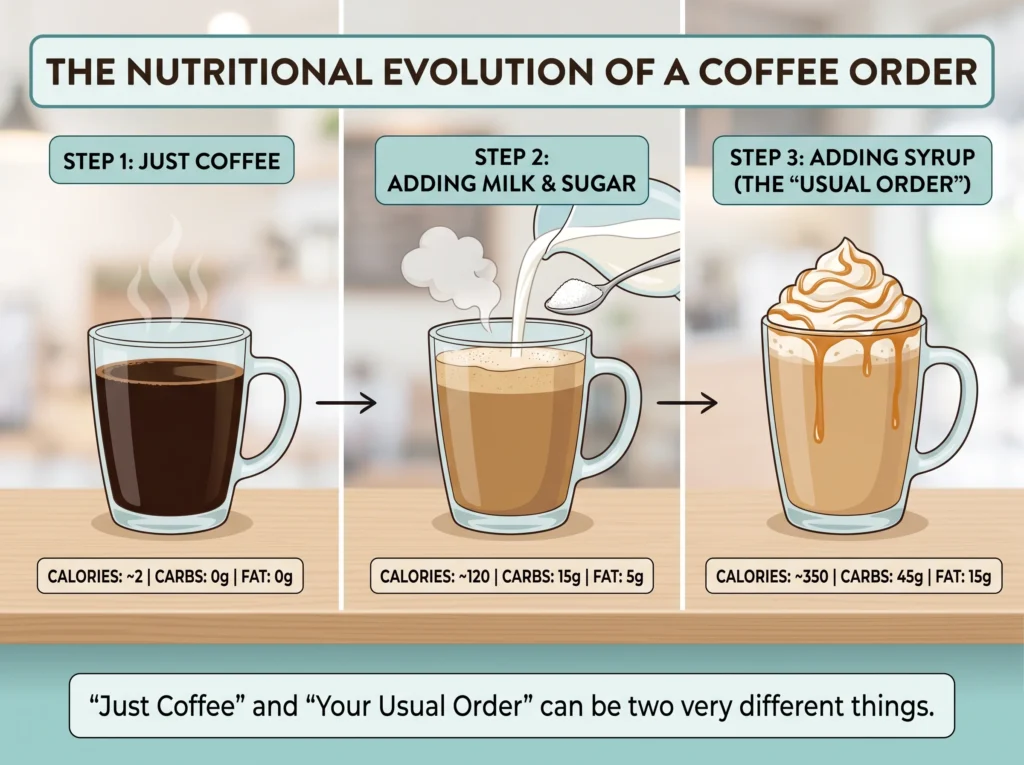
How Sugar and Cream Change Your Coffee Macros
Sugar, cream, and flavored syrups don’t show up in “coffee” — but they show up in your daily totals, especially coffee fat and sugar. Here’s what small additions actually cost:
| Add-On | Calories | Carbs | Fat |
|---|---|---|---|
| 1 tsp sugar | ~16 | 4g | 0g |
| 1 tbsp heavy cream | ~50 | 0.5g | 5g |
| 1 tbsp half-and-half | ~20 | 0.6g | 1.7g |
| 1 pump flavored syrup | ~20 | 5g | 0g |
It adds up fast. Two sugars and a splash of cream can turn a 5-calorie black coffee into a 100-calorie drink — before the milk is even counted.
Coffee Macros for Keto, Fasting & Weight Loss
Keto: Black coffee, Americano, and cold brew are all keto-friendly with 0g net carbs. Avoid sugar, oat milk, and flavored syrups — they’re carb-heavy. Heavy cream is the safest fat add-on.
Intermittent Fasting: Plain black coffee, espresso, and Americano won’t break a fast. They have no real calories, protein, or carbs to trigger digestion. Milk, cream, and sugar will break a fast because they contain calories and protein.
Weight Loss: Switch to nonfat or almond milk, skip the syrup, and use a sugar substitute if needed. This alone can cut 100–150 calories per cup without changing your order.
Building Muscle or Hitting a Protein Goal: If you’re trying to add protein to your day, a latte or cappuccino made with dairy or soy milk is a small but easy win — a Grande latte alone adds 13g of protein. Black coffee won’t help here since it has no protein at all, so this is really about the milk you choose, not the coffee itself.
Track Your Coffee Macros Instantly
Manually adding up milk, syrup, and sugar gets confusing fast — especially when you customize your order. The easiest way to know exactly what you’re drinking is to check it before you order.
👉 [Try the Starbucks Calories Calculator] pick your drink, size, and milk, and see the calories, protein, carbs, and fat instantly. No math required.
Related Coffee Nutrition Guides
Want to check a specific drink? Explore these guides:
- Starbucks Calories
- Coffee Calories
- Espresso Calories
- Latte Calories
- Cappuccino Calories
- Cold Brew Calories
(Swap these placeholder links for the matching URLs on your own site.)
Coffee Macros FAQs
Does coffee have carbs?
Plain black coffee has 0g carbs. Carbs come from milk, sugar, syrup, or cream added to it.
Does coffee have protein?
Black coffee has 0g protein. Coffee with milk has protein — a Grande latte has about 13g.
Is coffee good for keto?
Yes. Black coffee, espresso, and Americano are all keto-friendly. Just avoid sugar, oat milk, and sweet syrups.
What is the lowest-calorie coffee order?
Black coffee, espresso, or an Americano with no add-ons. All are under 20 calories.
Does milk type really change the macros that much?
Yes. Switching from whole milk to almond milk in a latte can cut over 100 calories and 7g of fat.
Does sugar in coffee count as a carb on a low-carb diet?
Yes. Sugar is a carbohydrate no matter where it’s added. One teaspoon adds about 4g of carbs, so two or three teaspoons a day can quietly add up to 10–12g of carbs from coffee alone.
How many macros are in black coffee?
A standard 8 oz (240 ml) cup of plain black coffee contains virtually no macros. It has about 2–5 calories, 0g protein, 0g carbs, and 0g fat, making it an excellent choice for low-calorie, keto, and fasting-friendly diets
Do coffee beans contain carbs?
Roasted coffee beans contain small amounts of carbohydrates naturally, but these are not present in meaningful amounts in brewed coffee. A cup of plain black coffee has 0g of carbohydrates because only a small portion of the bean’s compounds ends up in the finished drink.
Does coffee break ketosis?
No. Plain black coffee, espresso, and an Americano are keto-friendly because they contain almost no carbohydrates. However, adding sugar, flavored syrups, or sweetened milk can increase carb intake and may make it harder to stay in ketosis.
Are coffee macros different with almond milk?
Yes. Adding almond milk changes the nutrition profile of your coffee. Unsweetened almond milk is lower in calories and carbs than dairy milk, so it keeps your drink lighter. For example, replacing whole milk with unsweetened almond milk in a latte can significantly reduce calories, carbs, and fat while also lowering the protein content.
Final Takeaway
Coffee itself is nearly macro-free. Your calories, carbs, fat, and protein come from what you add — milk, sugar, cream, and syrup. Know your order, check your numbers, and you can enjoy coffee without any guesswork.
Cheak Starbucks Nutrition & Starbucks Calories Calculator and stay on top of your macros, one cup at a time.
Nutrition values are based on USDA FoodData Central and official Starbucks Nutrition Guide.
Great content! Keep up the good work!
Thank you so much! I really appreciate your kind words and support. I am glad you found the content helpful. Stay tuned—more useful Starbucks nutrition and calorie guides are on the way!